.svg)



Is it better to buy a new or existing property?
New properties are defined by Article 257 of the General Tax Code as buildings that have been completed for no more than five years .
Conversely, a property is considered existing if it was built more than 5 years ago or if it has already changed ownership.
Buying a new property, just like an existing one, has its own advantages and disadvantages. The right choice depends primarily on your profile (e.g., first-time buyer, investor, etc.), your financing capacity, your personal tastes, and your desired move-in date.
In this article, we have gathered everything you need to know to help you decide between buying a new or existing property.
Sale price and acquisition costs
First of all, the sale price of an existing property is often lower than that of a new homeOn average, the price per square meter for existing properties is 20% to 30% lower than for new builds.
However, in certain major cities where housing demand is high, the price of existing properties is comparable to that of new ones.
Furthermore, it is important to take notary fees into account. For an existing property, these acquisition costs generally amount to 7-8% of the sale price, compared to only 2-3% for a new property. For example, for a property sold at €250,000, notary fees range between €17,500 and €20,000 for an existing property, and between €5,000 and €7,500 for a new one. That is a difference of €10,000 to €15,000.
Comfort and interior design
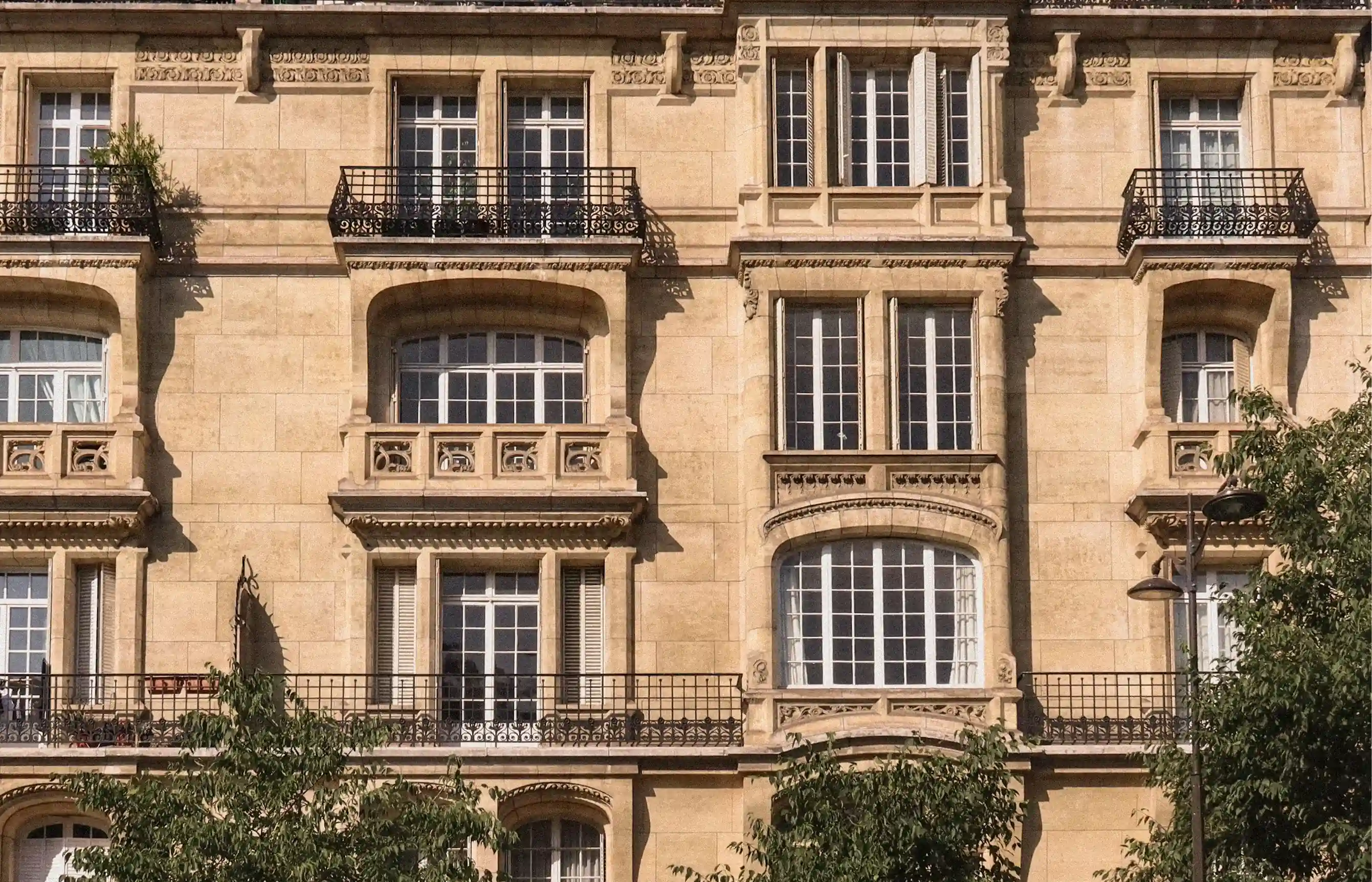
An existing property comes with a sense of history and unique charm. Exposed beams, period stonework, marble fireplaces—these authentic details give older homes an atmosphere that is often impossible to find in new builds.
However, new properties more frequently include amenities that are rarer in older homes: spacious elevators, underground parking, large floor-to-ceiling windows, balconies, terraces, and more.
Although existing properties are generally more affordable, purchasing them sometimes involves renovation costs. This might simply mean repainting certain rooms, but at times, more extensive work must be considered, such as upgrading electrical systems, improving insulation, or modernizing the heating system. Before buying, it is therefore essential to consult a professional to obtain a quote that lists and estimates the renovation work required after the purchase.
That said, building your own home or buying a property that requires renovation offers great freedom to customize the interior of the house or apartment. Indeed, building or renovating a property allows you to transform every room according to your personal tastes and create a comfortable living space tailored to your household's needs.
By choosing Maison Kyka, you are supported at every stage of your property purchase to ensure your project goes as smoothly as possible. Once the sale is complete, our interior design studio takes over to offer you a turnkey renovation for your new home.
“Despite my lack of time and experience in this area, Kyka turned the purchase of my primary residence in the 15th arrondissement into a smooth and pleasant experience. I highly recommend their services”
Nans R.
Energy performance
New properties are mostly built to meet the latest environmental and energy standards. Often rated A or B on the energy performance certificate (DPE), these homes feature high-performance thermal and acoustic insulation, thereby reducing energy costs. This is a real asset at a time when energy prices are rising and new environmental standards aim to reduce the carbon footprint of homes. That said, stay vigilant, as not all new properties have excellent energy performance.
Improving the energy rating of an older property can be a profitable investment. Faced with tightening legislation, some owners are looking to sell quickly because they cannot afford the necessary renovations.
As a buyer, this gives you the opportunity to:
- negotiate the sale price of the apartment or house to be renovated,
- quickly increase the property value through renovation work.
In recent years, the real estate market has gone through a serious crisis. However, several positive signals suggest that the market is regaining some momentum. 2025 could be a good time to invest in real estate because supply remains (for now) higher than demand, putting buyers in a strong position.
Geographic location
Whether you are looking to buy your primary residence or invest in a rental property, location is a key factor.
If you want to buy in the city center to be close to shops or public transport, the market for older properties is a better choice, as they are generally much better located.
New developments are often relegated to the outskirts, as that is where available building land is found.
Maintenance costs and fees
Buying a new propertymeans choosing peace of mind. With this type of home, you won't have to spend your weekends doing DIY or planning major renovations in the near future. Buying new generally comes with a period free of "major work," a significant advantage for those who want to avoid unpleasant surprises.
On the other hand, the older a property is, the higher the risk of needing maintenance or renovation work in the short or medium term. It is therefore essential to know how to ask the right questions when viewing an apartment or house so you can anticipate any work needed or equipment that may need replacing in the near future.
By buying a property as-is, you accept that it may have suffered some wear and tear, with no recourse against the seller for hidden defects discovered after the real estate transaction is complete.
Choosing a new home also means benefiting from a series of guarantees that protect you against various risks of damage or construction defects. In the case of an off-plan purchase (VEFA - Vente en l'État Futur d'Achèvement), which involves buying a property that is yet to be built or is currently under construction, these guarantees include:
- The guarantee of perfect completion : covers non-compliance issues and defects for the first year.
- The two-year guarantee : ensures the proper functioning of equipment (doors, windows, shutters, etc.) for two years.
- The ten-year structural guarantee : covers issues related to the building's structural integrity, such as foundations or waterproofing, for ten years.
- Structural damage insurance : it covers defects and poor workmanship that compromise the structural integrity of the building (e.g., wall cracks, floor subsidence, etc.)
If you are buying an apartment, you are entering into a co-ownership. It is therefore crucial to review the co-ownership agreement and anticipate regular expenses or any upcoming work. These costs may include the maintenance of common areas, the elevator, or the parking lot.
Before signing a sales agreement or a preliminary contract for an existing property, it is advisable to carefully analyze current charges and inquire about any work approved at general meetings that has not yet been carried out. Also, check the scheduled dates for capital calls so you can factor these costs into your budget and, if necessary, include them in your financing application.
By signing a property search mandate with Maison Kyka, one of our real estate project managers will take care of finding the property that meets all your criteria. Thanks to their expertise in renovation, our project managers know how to spot properties that, once refurbished, can offer you high energy performance, comfort that rivals new builds, and a significant capital gain when the time comes to sell your primary residence to buy another.
"From the search for the property (a real needle in a haystack given how many criteria we had) to the completion of the work and the final delivery (on time!!!), everything went very well. The team was very supportive, and the architect was high-quality (attentive and provided excellent advice). And above all, an apartment even better than we had hoped for. I recommend Kyka"
Amine Achite
Timeframe before moving in
Buying a new property off-plan (VEFA) often requires patience. Indeed, it can take between one and two years for the property to be delivered, depending on construction site variables and the geographic area. This means that after signing the reservation contract, you will have to wait an average of 12 to 18 months to move into your home. Unfortunately, it can happen that a new property is delivered several months late: on average, one in three buyers experiences a delivery delay of 5 months (source: UFC-Que Choisir survey).
On the other hand, buying a new or existing property allows you to become a homeowner in just a few months. On average, the time to finalize the purchase of an existing property after signing the preliminary sales agreement is about three to four months. This advantage is particularly appreciated by buyers who are eager to move in quickly or to make a rental investment without delay.
However, if you plan to carry out renovation work immediately after the sale is finalized, your move-in (or that of a tenant) will have to wait a few months while the renovation work is completed.
Real estate investment incentives
Property tax exemption
By investing in a new property to be built, you may be eligible for a partial property tax exemption (excluding the household waste tax) for the first two years following the construction of your home. This tax break applies starting from January 1st following the completion of construction work.
However, some municipalities reserve the right to limit property tax exemptions for certain new constructions within their territory. Depending on budgetary choices and local priorities, the property tax relief may therefore vary or even be eliminated.
Purchasing an older property does not typically qualify for this exemption, with one specific exception: for homes completed before January 1, 1989, you may be eligible for a partial property tax exemption (ranging from 50% to 100%) for three years if you undertake energy efficiency improvement work costing more than €10,000 including tax (excluding the purchase of materials and equipment). This measure is designed to encourage investment in energy-efficient renovations and support homeowners looking to improve their property's energy performance rating (DPE). However, to qualify for this exemption, the work must be carried out by an RGE-certified (Reconnu Garant de l'Environnement) professional.
Assistance for purchasing new or existing properties
Acquiring a new or existing home comes with a range of grants and schemes that reduce the total cost of a real estate investment. Many of these incentives are provided by local authorities and the state, often subject to income requirements, to help make homeownership more accessible.
One of the most beneficial forms of assistance is the zero-interest loan (PTZ), aimed at first-time buyers, meaning individuals making their first real estate purchase. This interest-free loan can cover up to 40% of the purchase price of a primary residence.
Certain urban redevelopment zones benefit from a reduced VAT rate of 5.5% for new homes, which is a significant reduction compared to the standard 20% VAT rate. This measure is intended to encourage the revitalization of neighborhoods undergoing transformation while making new housing more affordable for buyers.
Regarding tax relief, the landscape has changed significantly since the final end of the Pinel and Pinel+ schemes. For investors who finalized their purchase before this deadline, tax benefits continue to apply for the chosen commitment period (6, 9, or 12 years), remaining a key pillar of their wealth management strategy today.
The 2026 market is now focused on the Non-Professional Furnished Rental (LMNP) status, which allows for significant tax deductions or optimized depreciation.
Conditions for qualifying for LMNP (Non-Professional Furnished Rental) status:
- Property type: The property must be decent and include mandatory minimum furnishings (bedding, stovetop, refrigerator, etc.) to allow the tenant to move in immediately.
- Rental income: Annual income from the activity must not exceed €23,000 per year or represent less than 50% of the household's total taxable income.
- Taxation: The owner may choose the Micro-BIC (50% flat-rate deduction on income) or the Réelregime, which allows for the deduction of all expenses and the depreciation of the property to reduce tax liability to zero.
- Registration: You must obtain a SIRET number from the commercial court registry within 15 days of starting the activity.
Renovation grants for older properties
When investing in older real estate, several grants are available to help finance renovation work, particularly regarding energy efficiency.
MaPrimeRénov’ is currently the primary grant for financing energy renovation work. Subject to income requirements, this subsidy is available to both owner-occupiers and landlords. The grant covers many types of energy improvement projects, such as insulation, heating system upgrades, or thermal insulation improvements.
To qualify for MaPrimeRénov’, certain conditions must be met:
- The property must have been built more than 15 years ago.
- It must be located in Metropolitan France or the French overseas departments (DOM).
- For landlords, the property must be rented out as a primary residence for a minimum period of 5 years.
The amount of aid varies based on income and is organized into different categories:
- MaPrimeRénov’ Blue: for very low-income households.
- MaPrimeRénov’ Yellow: for low-income households.
- MaPrimeRénov’ Purple: for middle-income households.
- MaPrimeRénov’ Pink: for higher-income households.
For particularly ambitious renovation projects, MaPrimeRénov’ Sérénité offers greater financial support. This scheme is aimed at low and very low-income households, provided that the planned work results in an energy efficiency gain of at least 35%.
Furthermore, renovating an older property allows you to benefit from thezero-interest eco-loan (éco-PTZ). This is an interest-free loan designed to finance energy improvement work in your primary residence. Available regardless of income, this loan can be combined with ANAH grants and covers work such as insulation, the installation of high-performance heating systems, or hot water production.
To reduce the cost of work, reduced VAT rates also apply:
- A 5.5% VAT rate for energy improvement work in primary and secondary residences over two years old.
- A 10% VAT rate for other improvement work, excluding reconstruction or expansion projects.
Finally, the Denormandie scheme (extended until December 31, 2027) encourages the revitalization of city centers. It allows investors to benefit from a tax reduction calculated on the total cost price (purchase + work), provided that dilapidated housing is renovated and returned to the rental market with guaranteed energy performance.
Conditions for benefiting from the Denormandie scheme in 2026:
- Location: The property must be located in an eligible area (cities in the "Action Cœur de Ville" program, ORT zones, or dilapidated condominiums).
- Renovations: They must account for at least 25% of the total project cost and improve the property's energy performance by at least 30%.
- Rental: The property must be rented out unfurnished as a primary residence for a period of 6, 9, or 12 years, in compliance with rent and tenant income caps.
- Caps: The tax benefit is limited to a base of €300,000 per year and a price of €5,500/m².
Conclusion
Your decision to buy a new or older property should primarily be based on your criteria, your profile, and your financing capacity. It is possible to make a sound real estate investment in both cases, provided you carefully evaluate the initial price and take into account the development of both the neighborhood and the property itself.
At Maison Kyka, we offer bespoke support to help you buy and renovate an older property with complete peace of mind. Specifically, our services include:
- Searching for a property that perfectly matches your criteria
- Architectural design with our architecture studio
- Carrying out renovation work (on schedule)
- Layout and furnishing of rooms (e.g., furniture assembly, custom carpentry)
By working with us, you can invest in an older property with peace of mind. Once the work is complete, you can rent out or move into an energy-efficient home, with all the modern comfort within the charm of a period property.



.webp)


.svg)