.svg)

What are the best neighborhoods in Paris for a real estate purchase?
Before investing in real estate, it is essential to identify the best neighborhood in Paris in which to carry out your project. This decision, often a major life event, deserves careful thought and planning. The French capital remains a popular destination for both French and international buyers, and demand remains strong. It is therefore crucial to carefully analyze the different geographical areas to find the ideal location.
A brief history of Paris
With a history dating back to antiquity, Paris has constantly reinvented itself over the centuries to become the political, cultural, and economic capital we know today. The City of Light has 20 arrondissements, whose boundaries more or less reflect its historic neighborhoods.
The arrondissement: an administrative division born of the French Revolution
The start of the French Revolution in 1789 marked a turning point in French history, accompanied by a series of major administrative reforms. The capital was much smaller then, still delimited in many places by gates and walls inherited from medieval fortifications. In 1795, 12 districts were created, following an increasing axis from west to east, distributed on both sides of the Seine. The arrondissement was born.

A redefinition of Paris under the Second Empire
It was not until the second half of the 19th century and the intervention of Baron Haussmann, then Prefect of the Seine, that Paris changed its face once again. Under his leadership, the suburbs surrounding the city, such as Montmartre or Belleville, and the two woods located at its eastern and western ends, the Bois de Vincennes and the Bois de Boulogne, are integrated and contribute to the redrawing of the arrondissements.
While it was initially decided that the numbering would follow the logic used until then, one detail posed a problem. A popular expression of the time, “to get married at the 13th arrondissement town hall,” referred to the era when Paris only had 12 arrondissements, and designated unmarried or even adulterous couples who would have been united in a non-existent municipality. However, the ongoing reorganization assigned the 13th arrondissement to the western districts of Paris, Auteuil and Passy, which caused a scandal among the wealthy, bourgeois populations living there.
To settle the matter, a new spiral-shaped numbering system was created, starting from the center and reaching the peripheral districts. The 13th arrondissement was thus relocated to the Left Bank, around Place d’Italie.

Paris districts with a unique identity
A witness to the transformation of Paris over the centuries, architecture is a major marker of the identity of the different arrondissements. We mainly find Haussmann-style buildings, symbols of Parisian architecture, located in the central and western districts of Paris, near the centers of political and economic power. This is evidenced by the 1st, 7th, 8th, and 16th arrondissements, and their main thoroughfares such as Avenue de l’Opéra or Boulevard Saint-Germain. Haussmann-style buildings, due to their character and location, remain the most sought-after properties on the Parisian market.
Some districts, remnants of the medieval era, are characterized by narrow, winding streets and low-rise buildings, sometimes featuring timber framing. The Marais district, straddling the 3rd and 4th arrondissements and spared from Haussmann’s major renovations, exudes a more intimate, exclusive atmosphere. Today, it is home to trendy cafes, designer boutiques, and diverse communities (LGBTQ+, Jewish), such as Rue des Rosiers.
While Paris is traditionally divided along an east-west axis—with the east encompassing historically working-class neighborhoods and the west consisting of more affluent areas—each bank of the Seine also possesses its own distinct identity. The Right Bank is distinguished by its cosmopolitan nature, cultural vibrancy, and economic dynamism, while the Left Bank evokes a more private, intellectual, and residential atmosphere.
Montmartre, in the 18th arrondissement, is arguably the most iconic neighborhood on the Right Bank: romantic, picturesque, steeped in history, and always buzzing with energy. Nestled against the hill of the same name and dominated by the imposing Sacré-Cœur Basilica, it attracts buyers in search ofa bucolic setting, almost village-like, despite the daily influx of tourists.
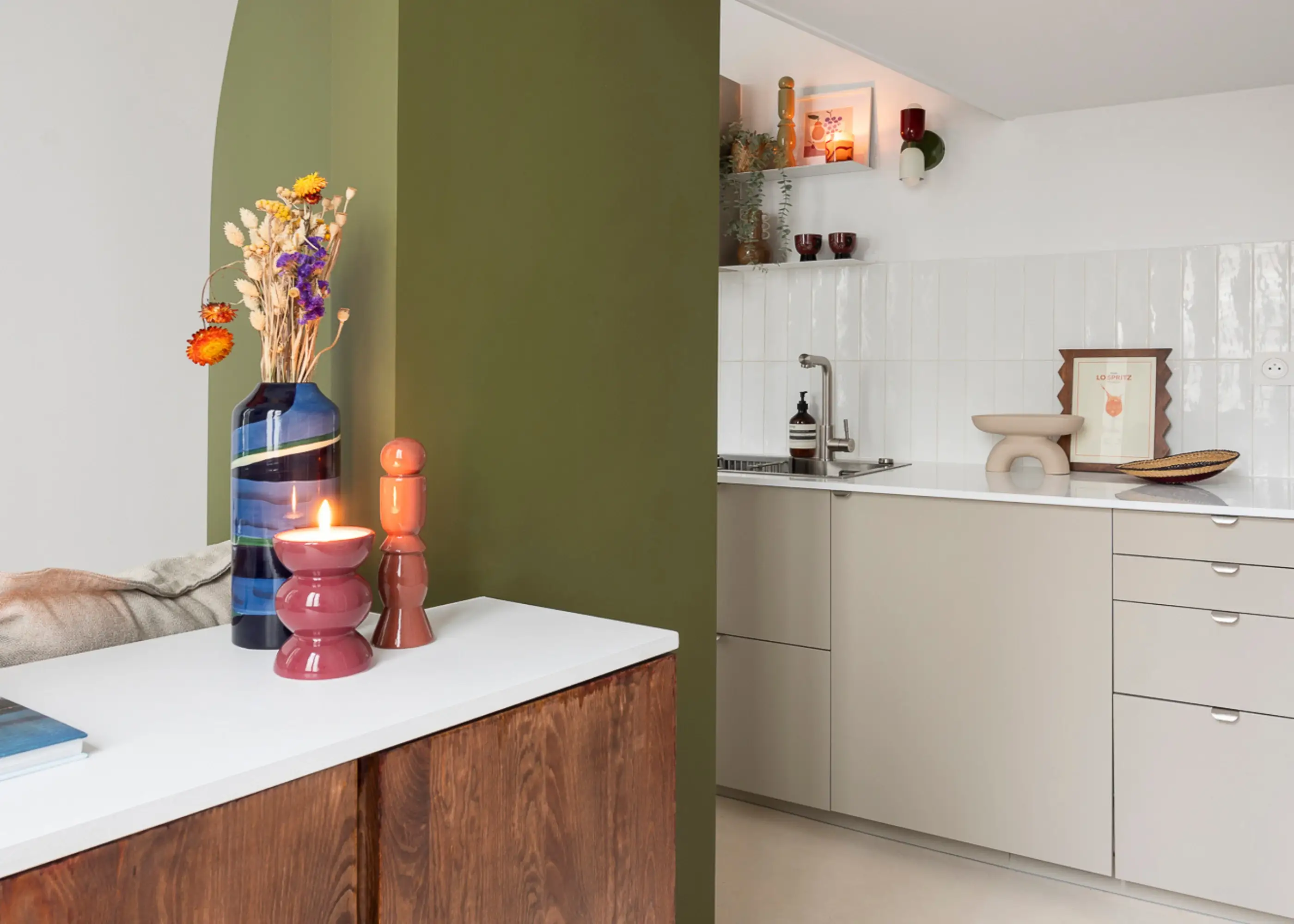
How can one talk about Paris without mentioning the Saint-Germain-des-Prés district? Located in the 6th arrondissement, it takes its name from the former abbey of the same name, founded in the 6th century. A hub of post-war intellectual fervor, it is home to iconic institutions like Café de Flore and Brasserie Lipp, once frequented by Jean-Paul Sartre and Juliette Gréco. Art lovers and aesthetes in search ofa bohemian lifestyle are easily won over by the elegant streets of this neighborhood, where real estate prices are among the highest in the capital.
Defining your real estate project
Between budgetary constraints and personal expectations, finding the ideal neighborhood to live in Paris can be a challenge. In a particularly tight market, it is best to prepare your project in advance to target viewings effectively and avoid disappointment.
Finding the ideal arrondissement for your budget
After several years of fluctuations marked by a notable drop in prices, the Parisian real estate market seems to be stabilizing, with a median value set at €10,501/m². The diversity of the arrondissements naturally comes with significant price disparities, which should be factored into your thinking when choosing the best neighborhood in which to invest.
Several arrondissements in the northeast of Paris stand out by offering affordable prices:
- The neighborhood of La Villette, in the 19th arrondissement, offers a dynamic setting thanks to its proximity to Buttes-Chaumont Park, the Ourcq Canal and Parc de la Villette, with attractive prices ranging from €7,110/m² to €8,366/m².
- The La Chapelleneighborhood, located in the 18th arrondissement, is undergoing a major transformation driven by numerous redevelopment projects. It represents an interesting opportunity, with prices still accessible at around €7,523/m².
- The Bellevilleneighborhood, in the heart of the 20th arrondissement, is the ideal spot for young professionals looking for a lively environment, where prices range between €8,673/m² and €9,193/m².

Unsurprisingly, prices rise sharply as you get closer to the heart of the capital, well exceeding the symbolic threshold of €10,000/m². Investing in neighborhoods like Les Halles, in the 1st arrondissement (median price of €12,069/m²), or in the prestigious Golden Triangle of the 8th arrondissement (€17,839/m²), remains a prime option, supported by sustained demand, high-end offerings, and the exceptional prestige of these areas.
Buying in Paris with a long-term perspective
Investing in Parismeans, above all, anticipating the long-term appreciation of your property's value. When purchasing, it is essential to consider future resaleby choosing a neighborhood with a dynamic that suggests price growth, even if that seems secondary at the time. Certain areas, currently undergoing gentrification, are experiencing significant development that can boost a property's value over the years. Anticipating changes in your personal or family situation can also guide your decision, while minimizing the need for frequent moves or neighborhood changes.
“When we decided to move on to another project, we were confident that the apartment would sell quickly and at the price we wanted. We didn't expect it to happen quite that fast!” Paul
Identifying risks
Beyond aesthetics and pricing, thinking about security is a reliable way to protect your investment's profitability and ensure a sustainable living environment. This involves looking at the presence of security services and the quality of urban management. Some areas may experience higher rates of burglary or antisocial behavior, which can impact your quality of life and the future value of your property. The risk of burglary is, for example, higher in central Paris, and the quality of street lighting in a neighborhood can be enough to significantly increase the sense of security.
Choosing a Paris neighborhood that suits you
The best district to bring your real estate project to life is undoubtedly the one that resonates most with your personality and your aspirations. With their expert knowledge of the Parisian market, the Maison Kyka team provides informed recommendations to guide you in your decision-making process.
Being realistic about your lifestyle to find the best neighborhood in Paris
Before rushing into a purchase, it is important to be realistic about your priorities. What kind of living environment are you looking for? A vibrant neighborhood, close to shops and cultural venues, but which might turn out to be noisy? Or perhaps a quiet setting with green spaces for the family, at the risk of being a bit further out? Depending on your work, hobbies, and desires, certain neighborhoods will naturally be a better fit. Furthermore, it is essential not to be influenced solely by aesthetic criteria or passing trends. Buying property in Paris must first and foremost meet your practical and personal needs.
Where to live in Paris for a first-time purchase?
For a first-time purchase, it is often best to target up-and-coming neighborhoods with good appreciation potential, but at prices that are still accessible. The 18th arrondissement, particularly around Jules Joffrin and Clignancourtis an area that remains affordable and offers interesting potential for appreciation. The 17th arrondissement, especially around the Épinettesarea, is also an excellent choice, with moderate prices and a sector undergoing significant development. These neighborhoods allow first-time buyers to settle in promising areas, close to transport and shops, while having a great opportunity for long-term value growth.
Where should a family move in Paris?
For a family, it is essential to prioritize a neighborhood that offers green spaces, quality schools, and a peaceful living environment. The 16th arrondissement, particularly between Passy and Victor Hugo, as well as the Daumesnil neighborhood in the 12th, stand out in this regard. Their respective proximity to the Bois de Boulogne and Bois de Vincennes, their varied selection of renowned schools, and their high-quality shops make them particularly sought-after places to live for families in search of balance and comfort.
Where to buy a pied-à-terre in Paris?
If you are looking for a pied-à-terre in Paris, neighborhoods like the 3rd and 6th arrondissements are essential choices, although prices can be high. These areas are perfect for those who wish to live in Paris a few days a week, thanks to their central location, their vibrancy, and their rich cultural offerings. If your budget is more limited, the 9th arrondissement can also be an excellent alternative, boasting a lively and central atmosphere while remaining more affordable than the 6th or 3rd. Furthermore, these neighborhoods benefit fromexcellent public transport links, making it easy to get around the city.

.svg)